Behind Unlimited: On Creating A Format
July 28, 2026 | Written by Tyler Parrott
Alternate formats are a necessary element to making a trading card game like Star Wars™: Unlimited successful. We knew this from day one, so as we were developing the game before launch we also wanted to explore other ways for players to play with their cards. There is a danger to having too many formats right away, as we didn't want to split our burgeoning audience, but having at least one other constructed format that was distinct from Premier was important.
Parameters and Priorities
Danny Schaefer, Jeremy Zwirn, and I had all been into TCGs long enough to see the rise and success of multiplayer formats, so we had concrete data on how that dynamic changes the way a game is played. Multiplayer was simultaneously both the most efficient and most expected alternative to Premier, so we started there. There were some reservations about being too derivative of other games in this regard, but we also didn't want to do something worse just because we wanted to be different.
Going into the design of our casual multiplayer format, we each had goals and priorities for what we wanted out of the experience:
- Danny cared a lot that the format be singleton, preferably with a larger deck size—one of the biggest things that makes other TCGs' multiplayer formats fun is that the games are naturally very variable, and with our core game mechanics being high-consistency we would need to lean harder into the forced variety to ensure games couldn't be repetitive. (For my part, I wanted our multiplayer format to work with whatever decks players wanted to build, but for branding and community-building reasons I got overruled.)
- I cared a lot that the format would not include player elimination, because one of my biggest frustrations with free-for-all multiplayer games is when one player gets eliminated early and then has to sit out the rest of the game (which could take over an hour). Therefore, I advocated for the idea that when a player was eliminated, the game would end and a winner would be determined.
- Jeremy was especially concerned with the initiative minigame, which would be largely invalidated when four players were competing over the token rather than two. The emotional experience of the players who couldn't take the initiative but also didn't get to go last was a negative one for him, particularly as they would be at a strategic disadvantage.
With priorities in mind, we did a few initial playtests. The idea that the game would end when the first player was eliminated was immediately compelling to all of us, as we liked the way it disincentivized ganging up on someone and it made the end game state dynamic and unpredictable. It also helped to keep games short—we wanted any given multiplayer game to be limited to 60 or 75 minutes to keep the game more casual and accessible. We discovered quickly that if players were allowed to pass (without claiming), they were heavily incentivized to do so, in order to get multiple uninterrupted actions at the end of the round, so a lot of nothing was occurring in the game. We didn't have a clear solution to Jeremy's concerns about the initiative, though we did try some early ideas such as turn order being sequential (the player who claimed second would go second, etc.) or adding a scaling reward for the player who claimed initiative second, third, and fourth.
It was around this time that the second wave of designers, Joe O'Neil, John Leo, MJ Cutts, and Ryan Serrano were hired. We were in the middle of developing Twilight of the Republic at the time, and while we wanted to get additional designers onto our main products as quickly as possible, we needed some amount of onboarding to acclimate them to our design processes, goals, and history. So Danny proposed a novel solution: the designers would participate in the development of Twilight of the Republic as playtesters, using that process to learn about how and why we built the cards in our sets, but at the same time they would lead the design of the multiplayer format we wanted to create. The first and second sets had already been locked, but we still had a bunch of time to design our multiplayer format before the game released in March of 2024. This would allow them to have a hand at designing something we needed for the game while not immediately throwing them into the deep end of card design.
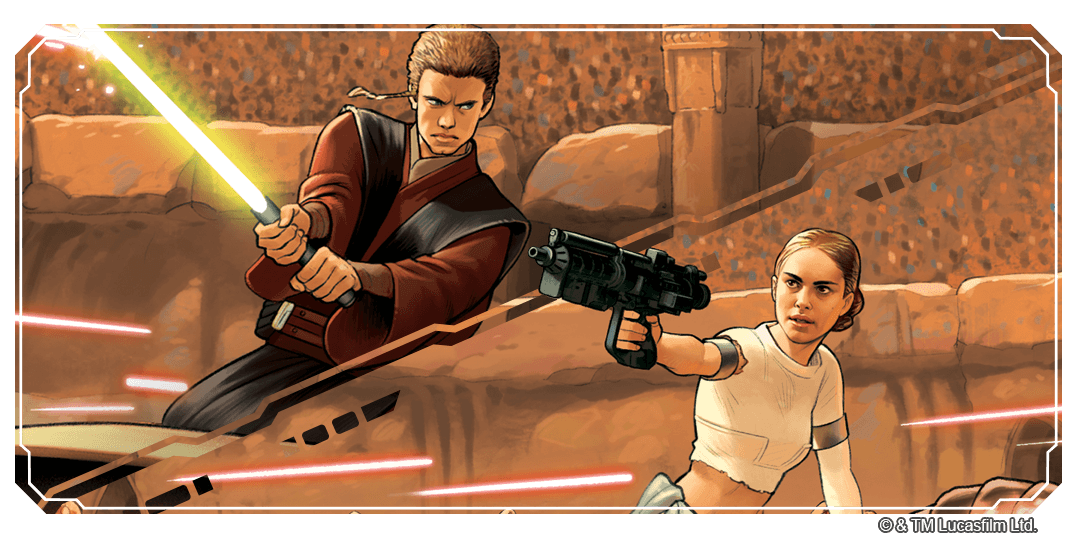
Finding the Twin Suns
The first step of any design process is, of course, the ideation stage. Danny, Jeremy, and I had laid the groundwork for the new designers by testing multiplayer games with the parameters that we cared about, but there were many questions left unanswered. The new designers met with each other, and with Danny, to get caught up on what we had started and to lay out the goals for the format. We wanted the format to still play like Star Wars: Unlimited but to also be a fun 4-player experience that prioritized different kinds of cards than Premier. This, then, is where the team started: how could they make the format feel distinct enough from Premier that the top performing cards in the competitive metagame wouldn't necessarily be the same as the top performing cards in this multiplayer format?
As I've mentioned, Danny was very attached to the “large deck size and singleton” nature of other games' multiplayer formats, as the enforced variety really supports the casualness of the format; and this format would, by design, be entirely a casual one geared towards less competitive players. The starting point of 100 cards was considered but quickly rejected. Even in other TCGs, the 100-card deck limit was deceptive, since multiple cards in that deck are essentially just resources, and the standard deck size for Star Wars: Unlimited was already smaller than those other games. The next number we tried was 80, and it was rapidly agreed upon as the target deck size for the format. Unfortunately, this presented an immediate problem: how would such a game mode be able to exist while only one set (Spark of Rebellion) was released? Players technically could do it, but they'd be playing almost every legally available card and that wouldn't make for exciting or compelling deckbuilding. We would need some way to make the format stay interesting in the first year of the game, before the card pool grew large enough to support the kind of game that this format wanted to be.
At the same time, other heuristics from those other games' multiplayer formats were floating around the design discussions. In those formats, players have twice as much starting HP so that games are less aggressive and last longer. This is good for making the games feel more varied and casual, but it also makes them take a lot longer to play (and we really didn't want to do that). But if we did decide to copy that idea, it would mean that players would have two bases—and that could expand the pool of aspects available to a player in deckbuilding. We didn't want to double the length of the game, but the added deckbuilding options were compelling.
Then, someone suggested two leaders instead of two bases. It was intended as a joke, and two of the designers (Ryan and John) didn't believe it would result in fun or fair gameplay. But…it did solve a number of deckbuilding challenges, and Danny loved how loud it was about changing the deckbuilding card evaluation to differentiate the format from Premier. We had to at least try it.
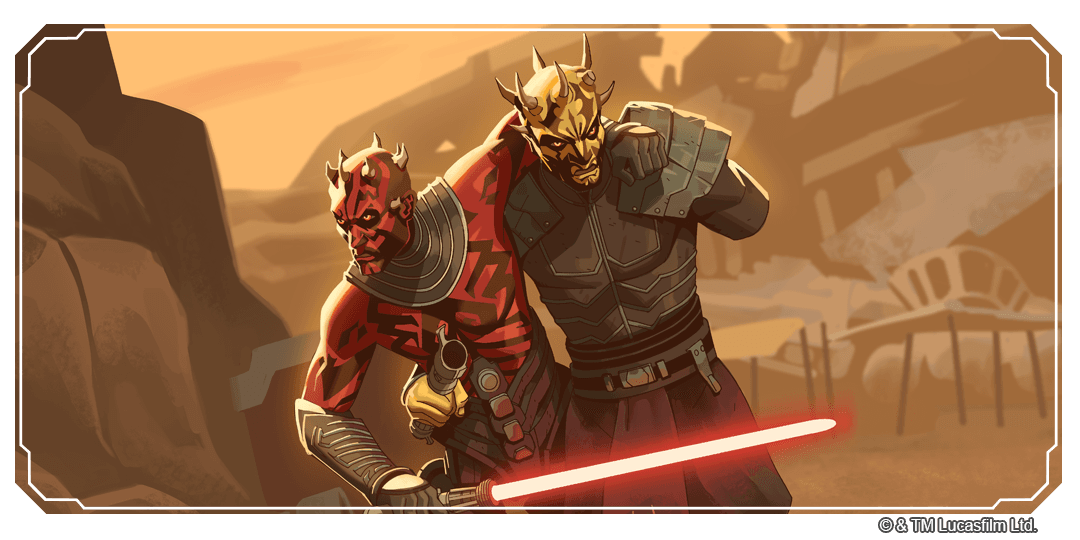
I don't believe any of us expected the “two leaders” concept to be as immediately fun as it was. Yes, it meant players could suddenly do a lot of things that were never intended when we designed and developed the first two sets, and the potential spikes in power that a single player could achieve were higher than in Premier. But when everyone is more powerful, the environment adjusts for it, and the “one action at a time” gameplay that the game is designed around naturally prevents one player from getting so far ahead that the other three players can't team up to keep them in check.
Adding a second leader provided so many unexpected elements of joy that it became the format's defining feature. It expanded access to aspects for deckbuilding, it gave players more actions to do during the game to make up for the removal of the “pass” action, it made the format immediately distinct from Premier, it gave value to cards that wouldn't get played in Premier, and it even had side effects for more story-focused players, such as inviting players to imagine circumstances in which their two leaders would team up. Ultimately, it gave the format its name: Twin Suns.
Contested Counters
Before they got to playtesting, the designers also worked hard at solving the problem that Jeremy had identified: how to keep the initiative minigame fun for the players who didn't take the initiative first. Their solution was to add more initiative counters to the multiplayer experience. One player could take the initiative while two others would take counters that provided different advantages. Sometimes it would even be correct to take a counter that wasn't initiative first, which provided a unique strategic twist! Some of the designers weren't all convinced at first that this would be the best solution, as it felt like an excessive additional mechanic being grafted onto the game, but playtesting ultimately showed that it was far more intuitive than they originally feared.
The first counters they tried were:
- The Initiative Counter, which determined turn order just like in Premier (and turn order would always remain clockwise)
- The “Heal” Counter, which healed 1 damage from your base when you claimed it
- The “Scry” Counter, which let you look at the top card of your deck and either put it on the top or bottom of your deck
The team understood immediately that the two additional counters would want to operate on completely different axes than the initiative, because it was important that none of the new counters feel obviously stronger or weaker than the others. Therefore, they chose one counter that was directed towards the game's final win condition (having the most HP on your base at the end) and one counter that helped mitigate the variance of an 80-card singleton deck.
Both of the new counters produced undesirable results. While the Heal Counter felt great to use, it was significantly increasing the length of games—instead of players having an average of 30HP on their base, they would have closer to 33 or 35HP each, depending on how many times an individual got to claim the counter. This usually added an additional round to the game, and with later rounds taking longer it meant games that averaged at or above 90 minutes. The Scry Counter was good at helping a player dig to a card they'd want, but it was too low-impact to feel good when it was taken.
The Scry Counter was an easy adjustment: if the purpose was to help you get to the card you wanted, then why not just simplify the process? The first revision therefore was:
- The “Draw” Counter, which let you draw a card when you claimed it.
The Draw Counter was perhaps the shortest-lived counter the designers tried, for reasons that veteran card players will understand: it was just way too strong. Why bother healing your base or going first when you could just have more cards than everyone else? The variance of the initiative minigame was gone, and everyone was only fighting over the Draw Counter.
Meanwhile, the team was trying to figure out how to make the Heal Counter work in a way that didn't lengthen the game. Ultimately it was Joe who found a solution in simple inversion: what if the counter accelerated the game instead of delaying it? Thus, the Heal Counter became the Blast Counter. It would still help a player win the game, but it would do so by reducing the HP on everyone else's base instead of increasing the HP on that player's own base.
With the Draw Counter out of consideration, the designers brainstormed what they could do that would be weaker than “draw a card” but stronger than “filter the top card of your deck.” Their solution was the Plan Counter: the person claiming it would draw a card, but then need to give up any card in their hand to the bottom of their deck. This would maintain the card filtering that they liked from the Scry Counter and the immediate access to cards that the Draw Counter provided, but without the blatant resource advantage of card draw and with more effective filtering options than were available from just filtering the top of the deck.
In the discussion of adding new initiative counters to make multiplayer work, the team also considered the possibility of having a pool of counters that allowed players to customize their play experience even further. While that option wasn't viable for a format that we had to market to a new audience, it is one with a modicum of support among the design team. If your group wants to play a longer game of Twin Suns, you could easily exchange Blast for Heal and get a different experience immediately!
The Endgame Puzzle
While my aversion to player removal was one that excited the design team, they discovered that it had some undesirable side effects. Usually, when a player's base is in danger of being defeated, there are enough units on the board (and usually ready) that triggering the end of the game comes at great personal risk—if I'm using my units to eliminate Joe, that's leaving my base vulnerable to being counter-attacked by Ryan and MJ and I won't be able to win. Players would get to the final round, but no one would be willing to commit to the final push.
So, how to incentivize ending the game? The most straightforward answer, of course, is to reward players for defeating a base. Bounties as a concept were already in the game, so the team explored possible “base bounties” that could be written into the rules. The first idea they had was “take an additional action,” with the idea being that you could set up a board state where, in one unbroken sequence, you could eliminate multiple players with a series of attacks. It was exciting in concept, but so difficult to set up in practice that it wasn't serving as a reliable option. Other bounties were discussed: ready the attacker (similar problem), shield your base (weird in the rules), and heal damage from your base.
One of the things that the team had found during playtesting is that healing a bunch of damage in one action was unusually powerful in Twin Suns, as it threw off the combat math for all three other players. When final remaining HP is a win condition, then being able to heal lots of damage at once can unexpectedly steal victory from another player. The Redemption (Spark of Rebellion, 52), then, was a huge bomb that everyone wanted to try to get into their deck, as it represented the greatest amount of healing on any card in the game. Given the value of Redemption, the idea of healing your base as a final win condition proved extremely appealing, and “heal 5 damage from your base” ended up being the perfect reward to encourage players to trigger the end of the game.
Find the Fun
One of the truisms of game design is that you want to “find the fun.” While we knew from previous experience that 4-player multiplayer would be enjoyable, the unique deckbuilding of pairing two leaders together, the fun tension of end-game sequencing, and the incredible variety of game states have made what could have been a good format into a great one. Multiplayer is especially effective at creating wacky, fun experiences because it removes the zero-sum tension of a regular competitive game. Oftentimes, the most fun way to play is specifically to include sub-optimal cards in your deck or to make sub-optimal in-game decisions, because it maximizes your experience at the table. One of the reasons that we make a tabletop game (instead of a digital one) is because it brings people together socially, and Twin Suns is the most social way to play Star Wars: Unlimited.
On a more personal note, the design of the format was also a memorable experience for the four game designers who created it, as it was the first thing that they created together and it was the source of a number of recurring jokes and patterns. The nickname “Hyperspace Joe” came from these playtests, when Joe would go out of his way to use the hyperspace card images to build his decks just so that they would look fancier on the table (even though it was just a playtest). And the decks that all four designers gravitated towards set certain expectations that have turned out to be mostly consistent for their styles of play:
- MJ played either Director Krennic (Spark of Rebellion, 1) and Grand Inquisitor (Spark of Rebellion, 11) or Cassian Andor (Spark of Rebellion, 13) and Han Solo (Spark of Rebellion, 17), two pairs of leaders that have clear synergy with one another.
- Joe played Chirrut Îmwe (Spark of Rebellion, 4) and Hera Syndulla (Spark of Rebellion, 8) so that he could make Chirrut as big a unit as possible with upgrades and Experience tokens.
- Ryan played Grand Moff Tarkin (Spark of Rebellion, 7) and Boba Fett (Spark of Rebellion, 15) with an Aggression base to prove that you could win without Vigilance cards in your deck.
- John played Iden Versio (Spark of Rebellion, 2) and Emperor Palpatine (Spark of Rebellion, 6) and then Jabba the Hutt (Shadows of the Galaxy, 6) and Bossk (Shadows of the Galaxy, 10) because he wanted to pilot a control deck.
You can think of Twin Suns as a playground: some players will use it as an avenue for goofy fun with thematic decks and entertaining wacky gameplay decisions, while others will use it to train a gymnastics routine as they try to optimize their path to victory through the uncertain landscape. Ultimately, there's no right way to play Twin Suns as long as you're having fun with your friends and making new, enjoyable memories.
Until next time, may you feel inspired to try something new.
Share This Post