Behind Unlimited: A Rotisserie Draft with Game Designers
January 29, 2026 | Written by Tyler Parrott
Almost a year ago, our game design manager Colin Phelps proposed a fun team-building activity: a “rotisserie draft” using the entire contents of the first 6 sets of Star Wars™: Unlimited. As you might imagine, for a bunch of game designers who were familiar with TCGs, the idea of a high-skill draft experience using a bunch of cards we had designed was extremely exciting, so we were eager to get started! There were twelve of us who participated in the draft: two design leads (myself and Danny), Colin the team manager, seven game designers (John, Joe, MJ, Ryan Serrano, Elijah, Michael, and Logan), and two game developers (Ryan Miles and Jorge).
Despite being originally intended as a “for fun” activity within the game's design and development team, I thought it was interesting enough as to warrant spotlighting in an article—both because I think the decisions made throughout are worth discussing, and because I think a rotisserie draft (often shortened to “roto draft”) is a particularly fun way to play the game for you to try with your friends!
A Format Introduction
For those unfamiliar with rotisserie draft, it's a form of drafting derived from fantasy baseball. (The specific name of the format is drawn from the restaurant La Rotisserie Française, where the pioneers of the fantasy baseball league would meet up to draft and compare scores.) Since its inception, roto drafting has become a popular format for some TCG communities, as it represents a cross-section between draft and constructed play that can't be experienced in any other format.
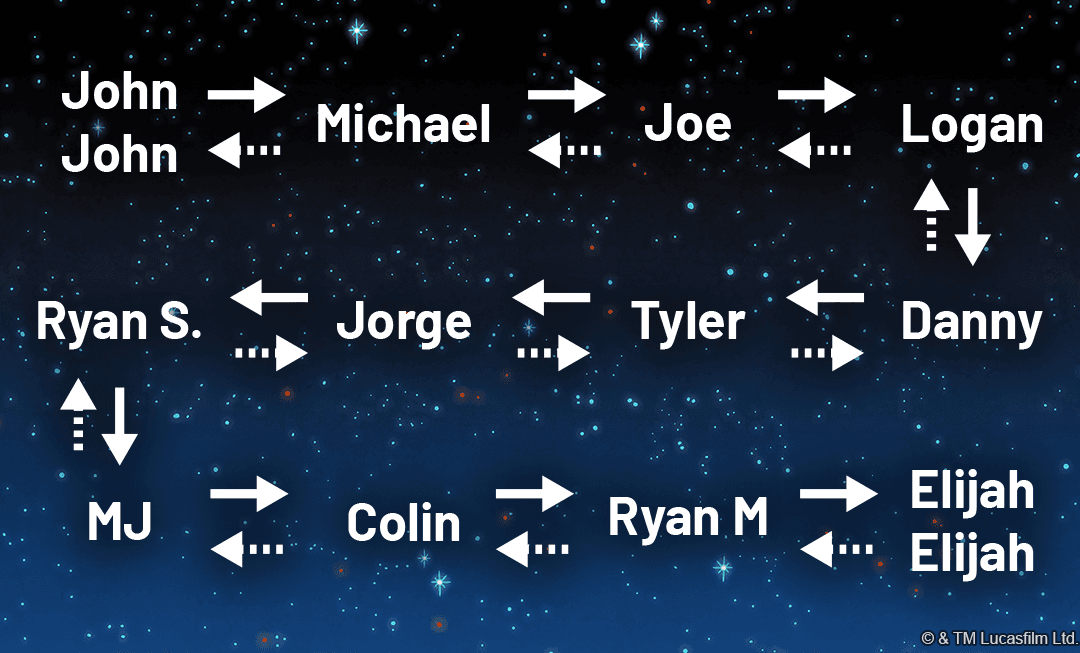
Just like in the fantasy baseball league that created it, a roto draft is done entirely face-up, with every game piece available from the beginning. In our case, that meant that the pool of cards that could be drafted was every card in the first six sets, though all of them were restricted to a single copy. Thus, if a player were to pick Death Trooper (Spark of Rebellion, 33) then no other player could pick that card, even though it was reprinted in Secrets of Power. Players make their selections in sequence; with all draft picks being public information and drawn from the same overall pool, it's impossible for two players to make selections simultaneously. This sequence is traditionally determined randomly, and the advantage of picking first is compensated for by utilizing “snake draft” rules: once everyone has made a selection, the pick order reverses and the person who picked last gets to now pick first in the subsequent round. This means that the players at the “end” of the draft order have the unique advantage of being able to pick two cards without interruption, but at the cost of having to wait for everyone else to have a turn before they get to pick again.
In the case of our draft, the order of picks was thus:
Expectations Shattered
Going into the draft, everyone had their own expectations for what strategies they and others might employ. Some had specific goals in mind, while others wanted to remain open, and everyone was angling for the most powerful cards. For instance, John and Elijah had specific plans (Vigilance-Command-Villainy control and heroic Rebels or Jedi, respectively), while the Ryans (Serrano and Miles) both opted for a more open-minded approach and targeted specific power outliers that they'd figure out how to use later. Danny, meanwhile, took a much more thoughtful and deliberate approach that married both ideas:
Danny: “My pre-draft evaluation was mostly thinking about what strategies and cards get meaningfully more valuable in a singleton, roto draft format—specifically one where the card pool is divided across 12 players. I pretty quickly identified two things that dovetailed well: there aren't very many high-quality cheap space units to go around, and answers to linear decks would be spread very thin (i.e. upgrade hate or spot removal for pilots). I also wanted to build a strategy that would be resilient to other drafters by having multiple options for leaders and aspect combinations. With that in mind, I staked my claim early on cheap, aggressive space units by going Green Squadron A-Wing (Spark of Rebellion, 141) into Black One (Jump to Lightspeed, 147). My Plan A was to go Aggression-Cunning-Heroism with Poe Dameron (Jump to Lightspeed, 13) or Kazuda Xiono (Jump to Lightspeed, 18) as my leader, taking advantage of the numerous cheap space units in Cunning, but pivoted off that when Michael took the Millennium Falcon (Spark of Rebellion, 193). With Command-Heroism open, I instead leaned into Aggression-Command-Heroism aggro, knowing that Poe, Sabine, Wedge, and Luke would all be solid leader options for me.”
While most people came in with a strategy in mind, a lot of the specifics on those strategies varied wildly. John, with the first pick of the whole draft, selected Energy Conversion Lab (Spark of Rebellion, 22)—something we all largely agreed was probably the best card in the first six sets. Ryan Serrano also identified that bases were the most irreplaceable game piece to take early, and was able to get Tarkintown (Spark of Rebellion, 25) as the 8th person to pick. MJ and I approached our picks with the theory that there was a wide gap between the best and the weakest 2-cost cards, taking Jar Jar Binks (Secrets of Power, 111) and Karis (Legends of the Force, 31) in our 9th and 6th spots respectively. Logan took a leader as his first pick, committing hard to the ever-flexible Han Solo (Shadows of the Galaxy, 13), and while Michael took Overwhelming Barrage (Spark of Rebellion, 92) as his first pick, he immediately made it very clear that it was intended as a “hate pick” to keep it away from the rest of us, and that he would not be drafting Command/Villainy. Boba Fett (Spark of Rebellion, 15) made it all the way to 10th place when Colin picked it up, with some drafters surprised at how early leaders were being taken at all and others shocked that Boba hadn't been picked earlier. By the end of the first round of picks, some of our expectations were met (Energy Conversion Lab, Boba Fett, Cinta Kaz, Resupply, and Shatterpoint) while many picks were wild surprises (Green Squadron A-Wing, Karis, Jar Jar Binks, and an unplayed Overwhelming Barrage).
Conspiring With Friends
Once the initial picks identified players' intentions, card selections had to take other players' priorities into account. Since all of the picks were made in a zero-sum environment, even the most powerful cards could wait until late in the draft if no one else wanted them, while more flexible cards became important to take early. And because people were trying to adjust their pick order to the players around them, it resulted in some pretty entertaining reactions!
Elijah: “There was a rush for space somewhere in the middle rounds, and I knew I needed to find some cards to deal with all of that. I ended up snagging more interaction early to fight that, but I still need more Sentinel units!”
Other unexpected sequences that occurred during the draft included one when players competed to take premium removal from each other (Takedown, Open Fire, Power of the Dark Side, Waylay) and another where the differing opinions of which units were most irreplaceable forced players to pivot in opposite directions:
Ryan Serrano: “I focused early on drafting mid-late game bombs because I figured their high impact on the game would be difficult to handle in singleton. 2-drops started drying up fairly quickly, though, so I unfortunately had to pivot to taking them earlier than I wanted to.”
Ryan Miles: “Expensive bombs went a lot faster than I expected, and it upped my priority on them more that I really wanted to. After committing to ramp so early, the amount of 6+ cost units that went in the first four rounds was a bit unexpected, and I felt like I had to start jumping on the ones I felt were the best.”
But reacting to the other players' picks was only half of the story. After all, player reputation and preconceived expectations are a huge factor in the prioritization of specific card selections. Ryan Serrano actively attempted to manipulate it to his advantage: “Folks would probably assume I was going Cad Bane and snipe early strong Underworld cards from me, so I hoped to feint in that direction and end up with Quinlan.”
The fact that we could talk to each other also meant that we could influence the draft outside of just our card selections. Once it became clear to both Colin and Elijah that they would be playing Cunning Force-trait decks, they made a private agreement to avoid taking any of the Cunning payoffs for the Force token mechanic until later in the draft. Operating under the trust of their agreement, both could prioritize the cards that the rest of us would compete with them for, so they could both end up with stronger decks at the end of the draft.
In a similar way, John and I quickly identified that we were both going to be playing Vigilance-Command-Villainy decks: four of his first five picks were Energy Conversion Lab, Takedown, Darth Vader (Legends of the Force, 37), and Timely Intervention (Shadows of the Galaxy, 129) while I started with Karis, Power of the Dark Side, Director Krennic (Jump to Lightspeed, 32), and then grabbed a fifth-pick Darth Vader (Spark of Rebellion, 87) to put me in Command. In order to improve both our chances, we discussed briefly what our priorities were and traded a short list of cards we wanted each other to avoid, so we could save them for later in the draft. In the same way, this conspiracy allowed us to build better decks against the rest of the drafters without sabotaging each other…although I would do that too, when I forgot that Huyang (Twilight of the Republic, 110) was on John's list and I sniped it from him earlier than we had promised! (He retaliated appropriately by taking the Lieutenant Childsen (Spark of Rebellion, 35) that I had been trying to direct my deck towards.)
But not everyone cooperated behind the scenes. Danny and Joe, both prominently pursuing Command, Aggression, and Heroism cards in different deck archetypes, actively competed for the best cards for their deck. Had they cooperated, then perhaps Joe could have had more useful early Jedi such as Gungi (Legends of the Force, 93) or Anakin's Interceptor (Twilight of the Republic, 142) and Danny could have had Poe Dameron (Jump to Lightspeed, 100) and Sabine's Masterpiece (Jump to Lightspeed, 250), but instead they spent many of the early rounds trying to predict which generically-strong card the other would want and taking it from each other. As Danny recounts: “In the end I think he took a lot more picks from me than I did from him.”
A Fresh Way to Play
Once the draft was complete and each player had their respective pools of 42 cards, it was time to play games against each other! As a roto draft is still a limited format, we followed all of the normal rules for draft play: each deck would contain 30 cards and players would need a leader and a base. The leader had to come from a player's draft pool, and a player could use a rare base they drafted, but any common base could be used in deckbuilding (meaning that anyone could use the Force token mechanic from Legends of the Force if they wanted).
Importantly, though, these games would be played as best-of-three matches, and the remaining cards a player drafted operated as their sideboard. Since all of our picks were made as public information, we could build our decks for even the first game of each match with full knowledge of what our opponent had in their pool. It meant that players could play mind games with each other before the first game even began, as they could try to either optimize their deck to defeat this specific opponent or they could try to psych their opponent out and build something slightly different.
This level of deck customization before and between games meant that the contents of a player's sideboard was especially important. But at the same time, the zero-sum nature of the draft also meant that players could hate-draft more effectively: Michael boldly started with taking Overwhelming Barrage and then building a Cunning-Heroism deck, and I made a targeted pick of Jango Fett (Twilight of the Republic, 16) to keep him away from Jorge. Other hate-draft picks included Bamboozle (Spark of Rebellion, 199), Superlaser Blast (Spark of Rebellion, 43), and Restock (Spark of Rebellion, 252). But every hate-draft pick came at the cost of a deck's flexibility, a cost that Logan made especially good use of:
Logan: “John Leo and I played two incredibly tight games that we split, fighting for the ground arena, with me struggling to deal with his Darth Vader/Energy Conversion Lab combo and Kylo Ren leader deploy. Then, for the third game, I essentially abandoned the ground arena, siding in all of my space units, and the game was a blowout.”
In the end, the twelve of us drafted the following decks:
John Leo drafted a Viglance-Command-Villainy control deck built around Kylo Ren (Legends of the Force, 1) and Energy Conversion Lab (Spark of Rebellion, 22), featuring plenty of removal and powerful Ambush synergy cards like Timely Intervention (Shadows of the Galaxy, 129), Darth Vader (Legends of the Force, 37) and Avenger (Spark of Rebellion, 40).
Michael Dunsmore drafted a Cunning-Cunning-Heroism tempo deck led by Han Solo (Spark of Rebellion, 17) that was focused on using the space arena to apply relentless pressure. The Millennium Falcon (Spark of Rebellion, 193) and Stolen AT-Hauler (Jump to Lightspeed, 221), backed up by Han Solo (Jump to Lightspeed, 203) and DJ (Shadows of the Galaxy, 213), provided threats that were very difficult for opponents to stabilize against.
Joe O'Neil drafted a Command-Aggression-Heroism Force deck that used Avar Kriss (Legends of the Force, 7) to power out big effects like Ki-Adi-Mundi (Legends of the Force, 146), General's Blade (Twilight of the Republic, 121), and Yoda (Legends of the Force, 101). Obi-Wan Kenobi (Legends of the Force, 8) and Kit Fisto (Legends of the Force, 11) were both in his pool as backup leaders, and both were put into the deck at various points during gameplay.
Logan Giannini drafted a Vigilance-Aggression-Heroism midrange deck that used Han Solo (Shadows of the Galaxy, 13) to always have a unit to play. He leaned into hand disruption as a primary strategy, with Pillage (Shadows of the Galaxy, 181) and Luthen's Haulcraft (Secrets of Power, 153) to shred opponents' hands and remove any counterplay for his expensive bombs, from Rey (Shadows of the Galaxy, 46) to Krayt Dragon (Shadows of the Galaxy, 172).
Danny Schaefer drafted a Command-Aggression-Heroism aggro deck led by Sabine Wren (Spark of Rebellion, 14) that prioritized the Piloting mechanic, including all of the normal hits such as Chewbacca (Jump to Lightspeed, 103), Luke Skywalker (Jump to Lightspeed, 94), and Biggs Darklighter (Jump to Lightspeed, 150). It also included staples such as Karis Nemik (Secrets of Power, 148), K-2SO (Spark of Rebellion, 145), and For a Cause I Believe In (Spark of Rebellion, 152) to guarantee that he could close out games.
Tyler Parrott (yours truly) drafted a Vigilance-Command-Villainy midrange deck that sought to get on the board early and apply constant pressure. Supreme Leader Snoke (Legends of the Force, 6) provided a consistent threat, with Huyang (Twilight of the Republic, 110), General Grievous (Twilight of the Republic, 34), and Darth Vader (Spark of Rebellion, 87) threatening a powerful offensive.
Jorge Zhang drafted a Command-Cunning-Villainy space deck built around Darth Vader (Jump to Lightspeed, 6). It had all of the tricks that the constructed version of the deck has, with Triple Dark Raid (Shadows of the Galaxy, 194) and Victor Leader (Jump to Lightspeed, 85) as haymakers while Waylay (Spark of Rebellion, 222) and Change of Heart (Spark of Rebellion, 224) ensured there was nothing to stand in his way.
Ryan Serrano drafted an aggressive Asajj Ventress (Twilight of the Republic, 14) deck using Tarkintown (Spark of Rebellion, 25) to stay ahead. With an early-game Force leader, he got to maximize many of the most powerful Force events—Force Throw (Spark of Rebellion, 167), Force Choke (Spark of Rebellion, 139), and Force Lightning (Spark of Rebellion, 138)—and used surprise damage from Hotshot DL-44 Blaster (Shadows of the Galaxy, 174) and Sneak Attack (Spark of Rebellion, 219) to end games on his terms.
MJ Cutts drafted an Aggression-Aggression-Villainy aggro deck with Boba Fett (Jump to Lightspeed, 9). It had ample damage sources from HK-47 (Legends of the Force, 130) to War Juggernaut (Jump to Lightspeed, 170) to of course the Devastator (Jump to Lightspeed, 143) with the straightforward goal of overwhelming the opponent with damage.
Colin Phelps drafted a Vigilance-Cunning-Villainy Force deck with Boba Fett (Spark of Rebellion, 15) as their leader. They got into the Force token mechanic fairly late, but they didn't need Force units because they had access to Vergence Temple (Legends of the Force, 19). This made the likes of Aurra Sing (Legends of the Force, 179), The Client (Shadows of the Galaxy, 31), and Chirrut Îmwe (Legends of the Force, 67) especially strong for them.
Ryan Miles drafted a Command-Aggression-Villainy ramp deck built around Dryden Vos (Secrets of Power, 7). He committed hard with Resupply (Spark of Rebellion, 126) and Superlaser Technician (Spark of Rebellion, 83) as his first two picks, and then was happy to play Bendu (Legends of the Force, 170), Maul (Shadows of the Galaxy, 90), and Palpatine's Return (Shadows of the Galaxy, 94) to finish games.
Elijah Montoya drafted a Vigilance-Cunning-Heroism Force deck that maximized synergy as much as possible. Obi-Wan Kenobi (Twilight of the Republic, 3) helped keep his units in play and he tried his best to cheat expensive units like Luke Skywalker (Spark of Rebellion, 51) and Qui-Gon Jinn (Legends of the Force, 200) into play with Now There Are Two of Them (Twilight of the Republic, 225) whenever possible.
Finding Improvements
Of course, drafting a fun game with your friends is always likely to be a good time, but one of the things I discovered was that I still had a lot to learn! Some of the players went into the experience with deckbuilding heuristics from constructed play (optimizing specific card interactions, trying to build for a high power ceiling, etc.) while others, including myself, went into it as if it were a high-powered limited format (optimizing for applying consistent on-board pressure with a high power floor, etc.). Ultimately, the people who had the most success operated somewhere in the middle: they had the ability to pop off with high power card interactions with enough redundancy to make sure their deck executed its primary strategy consistently. My deck had powerful cards, but none of them could steal a game out of nowhere because I was treating the format too much like a regular draft. John, meanwhile, had a different experience:
John: “I am a strong player of defensive strategies, but I think I applied too many heuristics from the constructed metagame rather than treating this draft as its own unusual format. This seems to have left me open to lose more games than I'd like! Next time, I'll plan to evaluate things more holistically.”
And as Logan experienced, “Being forced to delve deeper than normal into the card pool really reveals some diamonds in the rough. With the right framework around them, even cards that seem mediocre on paper can be elevated to above serviceable.”
If you're someone who enjoys gameplay variety and thinking deeply about Star Wars: Unlimited strategy, I have to recommend doing a rotisserie draft with your friends. It will be a fun social experience that's bound to make you more familiar with the card pool, so you can better evaluate cards in the future!
Until next time, may you feel inspired to try something new.
Share This Post