Star Wars™: Unlimited Starter Guide
November 20, 2026 | Written by Stephen Woodward
One of the most exciting parts of trading card games (TCGs) is that a single played card can tell a story.
Welcome to Star Wars™: Unlimited, a popular TCG from Fantasy Flight Games, where each card is the start of an incredible adventure representing a key character, action, or a crucial moment from Star Wars' long history of storytelling. Each new set released is an expansion of playable cards that often introduce new mechanics into the game to always keep gameplay fresh and exciting. With nine sets released since 2024, Star Wars: Unlimited features a vast collection of cards with hundreds of beloved Star Wars heroes, nefarious villains, iconic starships, and memorable moments—there's a reason it's called “Unlimited,” after all!
The adventure only gets better as you expand your collection, play and trade cards with friends, open booster packs, and build your own deck based on your own unique strategy. You may even decide to play competitively at a local game store!
We have an exciting new release to talk about that's geared for new players, but before we get to that, let's cover the basics of the game.
Getting Started
Each standard Star Wars: Unlimited deck has at least 50 cards and features a leader, base, unit cards, and various events, abilities, and upgrades. Players can use the pre-built Icons decks, expand them with cards from the starter box, or purchase additional booster packs to create that 50 card deck.
These decks are built around “aspects,” the symbols that help determine which cards fit naturally into your deck. Located in the upper left or right corner of each card, the game features six distinct aspects that define card function and overarching strategy: Vigilance, Command, Aggression, Cunning, Heroism, and Villainy. Constructing your deck begins by choosing a leader and a base. Together, their combined aspect icons—two from your leader and one from your base—determine the core identity and card composition of your deck. Cards without those aspects are still allowed in your deck, but you'll have to pay an aspect penalty of two resources, which makes the card more expensive to play than it would be normally.
Building your own deck is perhaps one of the most exciting parts of most TCGs, but especially Star Wars: Unlimited. This is your chance to think through a strategy, or maybe tell a story through a particular theme, cast of characters, or Star Wars era. Maybe you want to focus on the Clone Wars, or alien creatures, or epic space battles—the choice is up to you!
So, after you pick your leader and base, how do you build the rest of your deck?
You can have as many cards as you want, but in general you should aim for 50 cards to maximize getting the cards you want. Typically, decks are composed of roughly 25 ground units, 15 space units, and an additional 10 event and/or upgrade cards. You can adjust that however you want. Some decks lean more into space, others into the ground, and still others focus on controlling the battlefield with special effects! The only limit is your imagination.
Game On
Gameplay in Star Wars: Unlimited is snappy, fast, and constantly moving between two players back and forth, one action per player, until a player's base is destroyed. Let's go over some key concepts to get you up to speed:
In order to play a card, you'll need to spend resources. Since there aren't dedicated resource cards in the game, you have to choose which cards to place as resources, and it can be a tough decision to keep one card and put down another! Each player starts with two resources, and the drama intensifies they gradually grow until you have enough to amass incredible power and command a huge army or vast space fleet.
Speaking of armies and space fleets, Star Wars: Unlimited gameplay is very thematic because it draws inspiration from some of the series' most famous battles, dividing combat across two arenas: ground and space (which units go into which arena is listed at the top of the cards). Units played in one arena must attack enemy units in the same arena, unless otherwise stated.
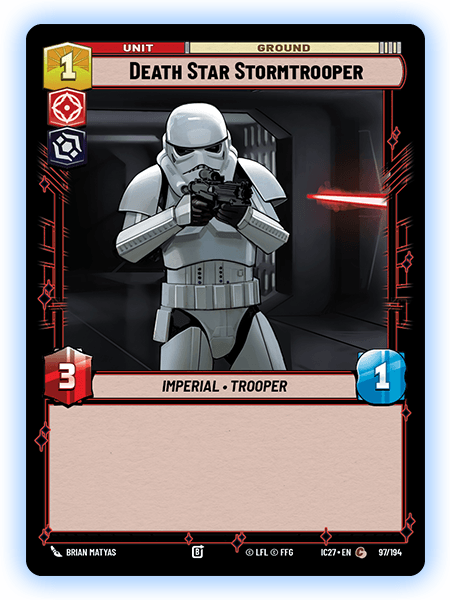
When units enter play, they are exhausted, which means they are turned on their side. When players have completed all of their actions for the phase, those cards ready up, signaled by the player turning them upright. As an action, a ready unit can attack, and then it becomes exhausted again. When a unit attacks another unit, both units simultaneously deal damage to each other equal to their power (the red number on its card), and if a unit ever has damage on it equal to or greater than its HP (the blue number), that unit is “defeated” and goes to the discard pile.
Each player performs a single action on their turn (whether it's playing a card, attacking, etc.), then their opponent performs one, and this alternating back-and-forth continues until the round concludes. When you are done taking actions, you can choose to pass or take the initiative token, which lets you take the first turn during the next round.
For a complete guide on how to play, check out the official tutorial here. If you have other friends or family who want to join, there's also a multiplayer mode you can try called Twin Suns.
Sometimes the challenging part of getting into a new game ecosystem like TCGs is that it can be daunting to know where to start. But don't fret! That's why we're excited to talk about the release of Icons 2027 Edition for Star Wars: Unlimited. This is the perfect entry point this holiday season for newcomers to both TCGs and Star Wars: Unlimited alike.
Welcome to Icons 2027 Edition!
Icons 2027 Edition is considered a “mini-set” of Star Wars: Unlimited, with fewer cards compared to regular sets, a focus on fan-favorite characters, and straightforward mechanics to help new players get started more quickly. Compared to standard sets, Icons booster packs have a lower price point and include nine cards instead of the usual sixteen.
Also unique to Icons is the introduction of the “booster 4-pack,” which is exactly what it sounds like: four Icons 2027 Edition booster packs bundled together into one larger package. Not only does it cost a dollar less than purchasing the four packs individually, but it also includes an alternate-art Cassian Andor unit card that can't be found anywhere else. For players on a budget, grabbing a couple of these 4-packs is an easy and affordable way to open multiple boosters without committing to an entire booster display.
For players who are completely new to Star Wars: Unlimited, the best way to jump in right now is with the Icons Starter Box, which gives two players everything they need to get into a game and even start to grow a collection. The box comes with a thematic game mat to help you navigate the play space, as well as two pre-built, 30-card decks that are designed to guide you and a friend through your first few games of Star Wars: Unlimited. Between each game, the box directs you to open a series of preset, non-randomized “deckbuilding packs,” giving you additional cards to add to your deck while teaching you the fundamentals of deckbuilding along the way. Once you've worked your way through all of the deckbuilding packs and feel comfortable with the game, you're rewarded with two full Icons booster packs to kickstart your collection!
Unlike a standard expansion with over 250 cards, this streamlined mini-set features just 194 cards. Every Common-rarity card consists of reprints from previous releases, though several showcase brand-new artwork. Select Uncommon cards are reprints as well—many also featuring updated illustrations. The remaining Uncommons, along with the entirety of the Rare and Legendary roster, introduce entirely new cards to the game. True to the name “Icons,” every single Rare and Legendary card in the set is a unique unit card highlighting a beloved Star Wars character!
Take the Lead
One of the unique characteristics of Star Wars: Unlimited is that each player selects a “leader,” which helps set the tone for their strategy, whether that's an aggressive playstyle that seeks to destroy a base or units as quickly as possible, a more control-oriented style that might heal your units or base, or even a disruptive style that slows your opponent's progression. With your chosen leader at the helm, the goal is to take down your opponent's base (dropping its HP to zero) before they can do the same to yours.
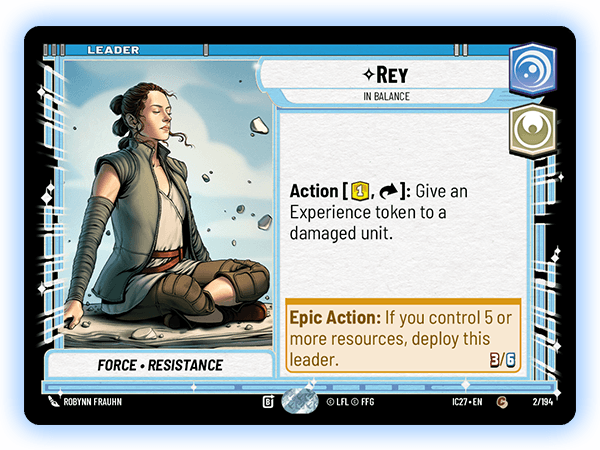
Each leader has a variety of elements that help shape your strategy. For instance, Rey (Icons 2027 Edition, 2) utilizes the Vigilance and Heroism aspects and has the “Force” and “Resistance” traits (listed below her artwork). You'll also notice that leader cards have two sides, and each has an important gameplay purpose. The horizontal side of the card is how your leader will start during a game. That leader's ability is listed in the white text area. In the above example, Rey's ability allows you to take an action and spend one resource in order to build up damaged units with Experience tokens, giving them +1/+1 power and HP.
Now what about the other side? One of the most exciting parts of Star Wars: Unlimited is that your leader can take an “Epic Action” once per game, which allows it to deploy onto the battlefield by flipping the leader over to directly engage in combat. This can often change the tide of battle, and it truly is epic! But it must be considered carefully, because deploying at the wrong time could also give your opponent the edge.
Once deployed, you'll notice that Rey's ability changes slightly. The effect is still the same, but instead of having to pay a resource and use an action, Rey just has to attack to bolster her damaged friendly units. When defeated, leaders return to their original horizontal position below your base and can't be deployed again for the rest of the game.
Let's look at two more leaders and see how they differ from Rey!
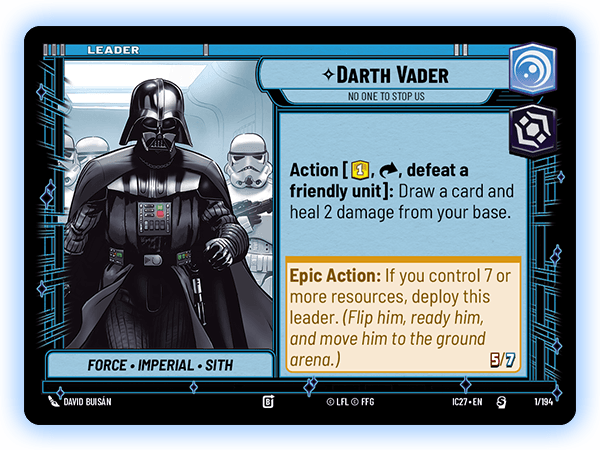
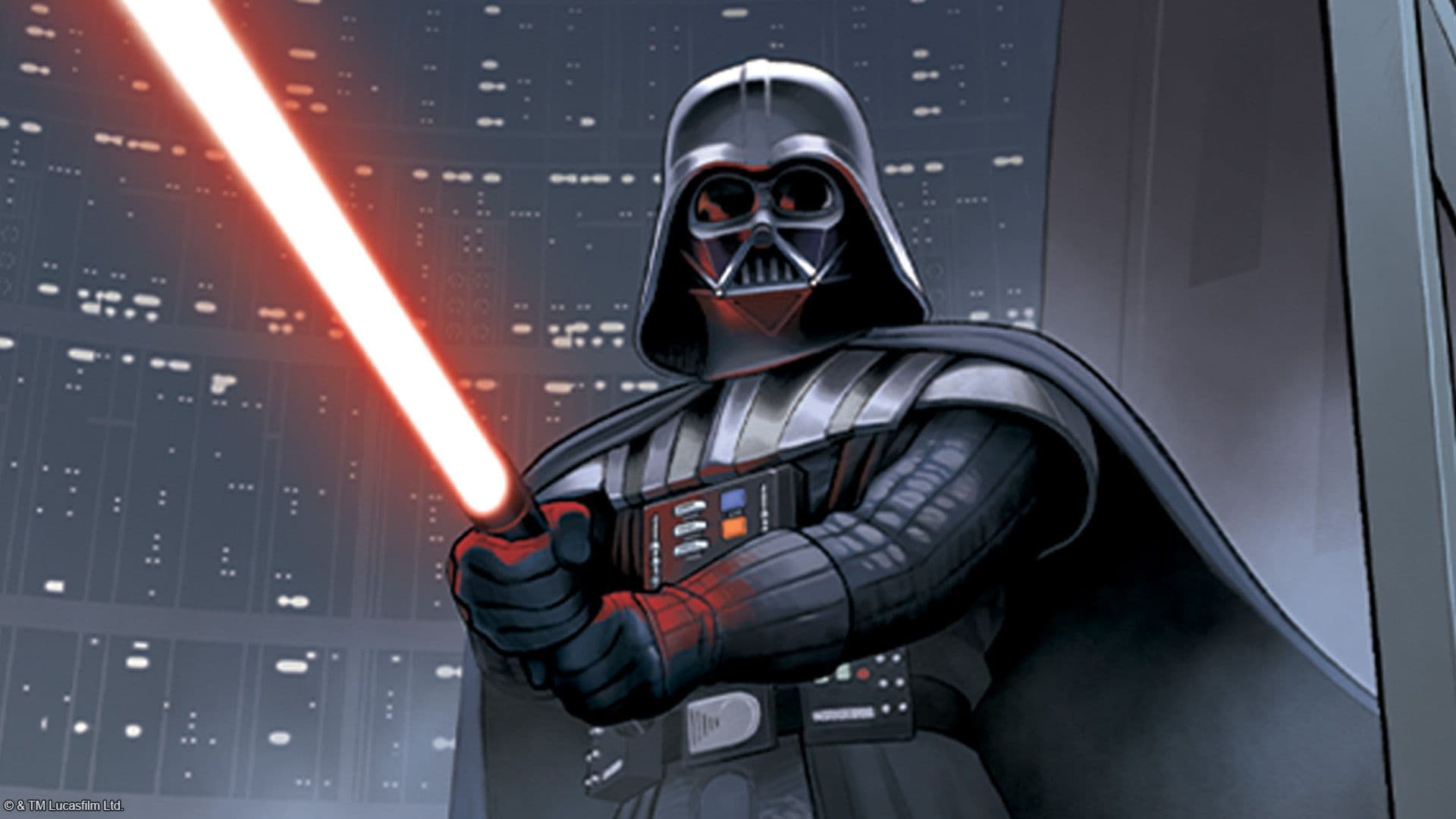
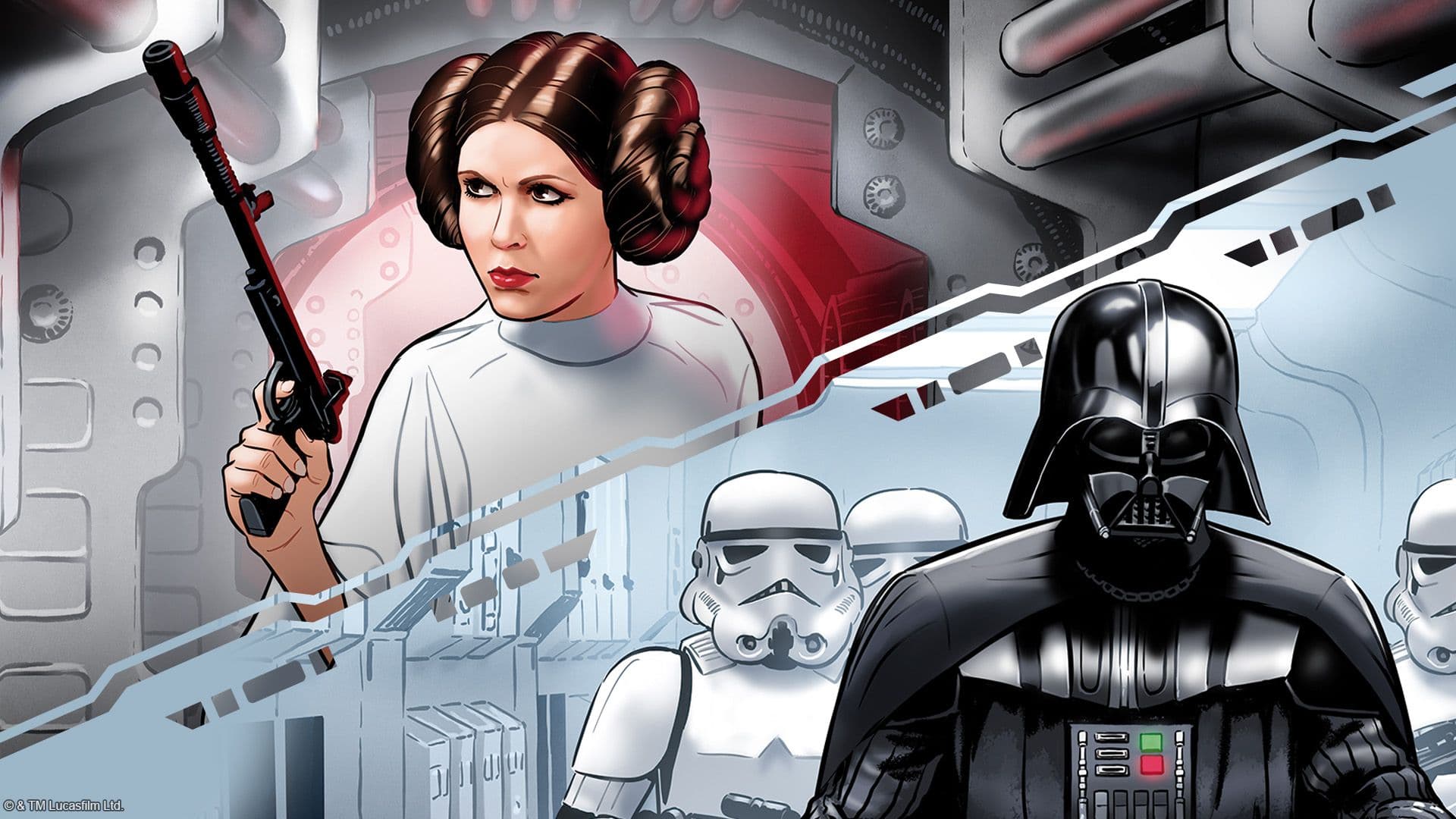
In Icons 2027 Edition, one of the other new leaders is Darth Vader (Icons 2027 Edition, 1). This leader utilizes the Vigilance and Villainy aspects and the “Force,” “Imperial,” and “Sith” traits.
Vader's ability comes with a large cost, but a powerful effect! You must utilize your action, spend a resource, and defeat a friendly unit in order to draw a card and heal two damage from your base. Similar to Rey, when you deploy Vader onto the battlefield, your attack triggers the ability instead (while keeping the same caveat that you must defeat a friendly unit to draw and heal base).
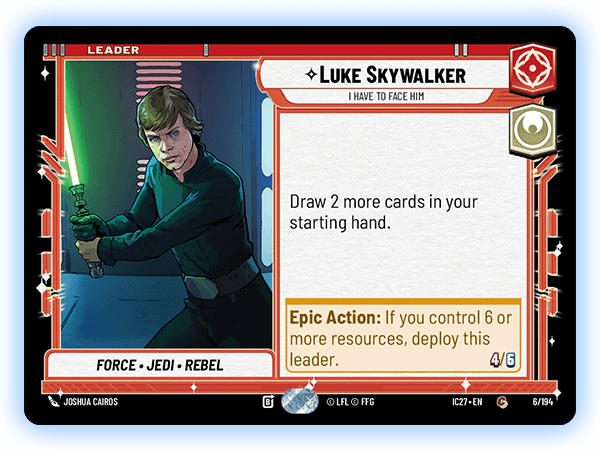
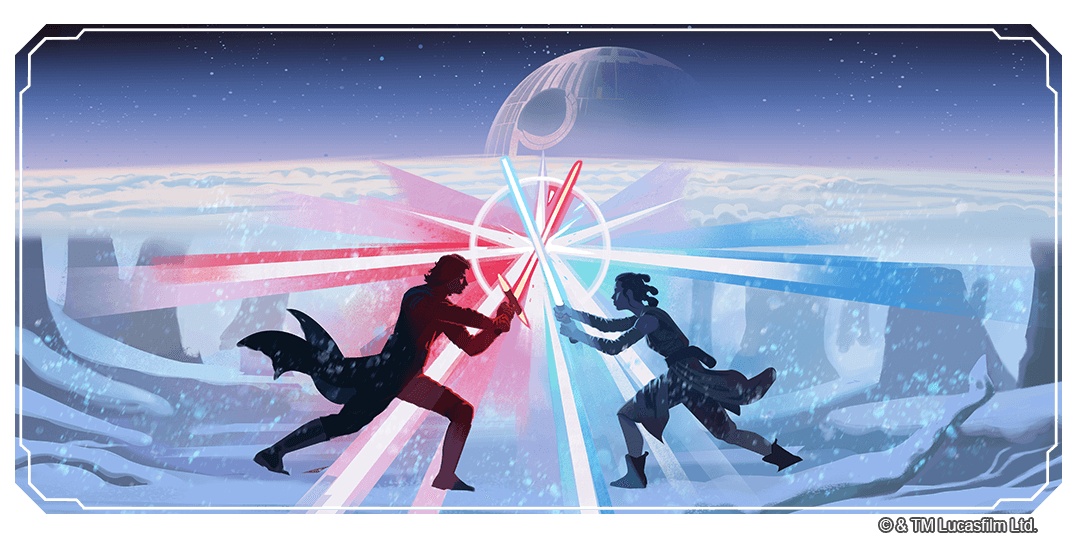
Facing off against his father, we have the Luke Skywalker (Icons 2027 Edition, 6) leader. Luke is most definitely ready for the fight, as his Aggression aspect tells you this character packs a punch. Luke's leader ability lets you get a head start on options by drawing two more cards in your starting hand for a total of eight before putting down your starting resources. When deployed at six resources, Luke really gets going. His “On Attack” ability lets you discard a card for two more power, plus his “Overwhelm” ability lets any excess damage heal deals to an enemy unit spill over onto the opponent's base.
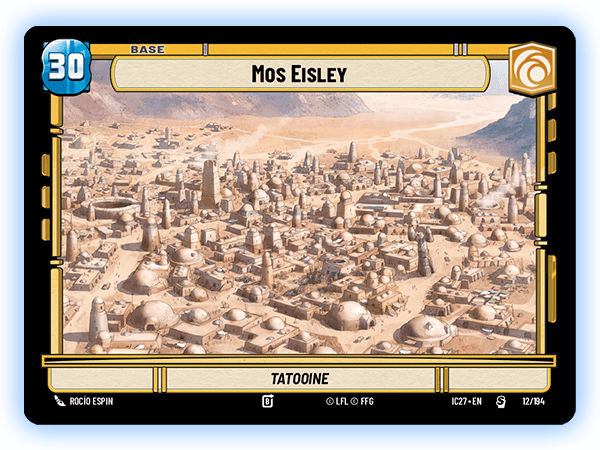
As for bases in this set, you'll see a handful of classic locations, such as the Mos Eisley base on Tatooine. This one is a 30-health base, which is the standard amount for most bases. In other sets, you'll notice that not all bases are created equal; sometimes they have other special abilities to compensate for lower HP values.
In most other sets, on the flip side of bases, you'll often find token cards. In Icons, these will be your Experience tokens, which grant +1 power and +1 HP (the Rey leader gives these out), as well as Shield tokens, which prevent damage once.
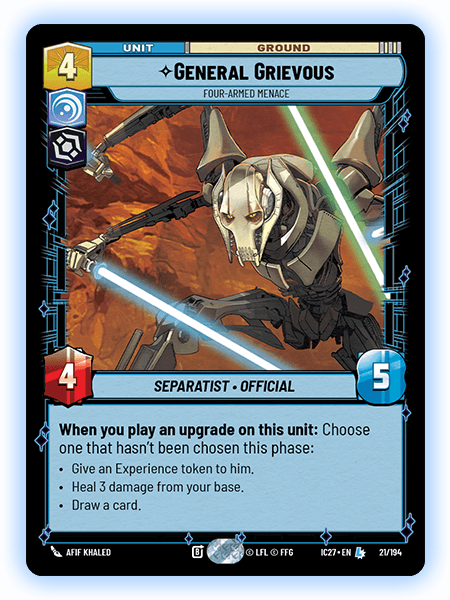
A card's rarity is highlighted in the bottom right: C for Common, U for Uncommon, R for Rare, L for Legendary, or S for Special, which are found on specific starter deck or promotional cards. As we mentioned earlier, every single Rare and Legendary card in the Icons set is a unique unit card featuring an iconic Star Wars character (or starship). Let's take a look at a few of these, starting with General Grievous (Icons 2027 Edition, 21). This four-armed menace is a little more complicated than other cards we've seen so far: when you play an upgrade on him, it triggers his ability, letting you choose a special action that hasn't been taken yet this phase:
1) Give an experience token to him
2) Heal 3 damage from your base
3) Draw a card.
Which would you choose first?
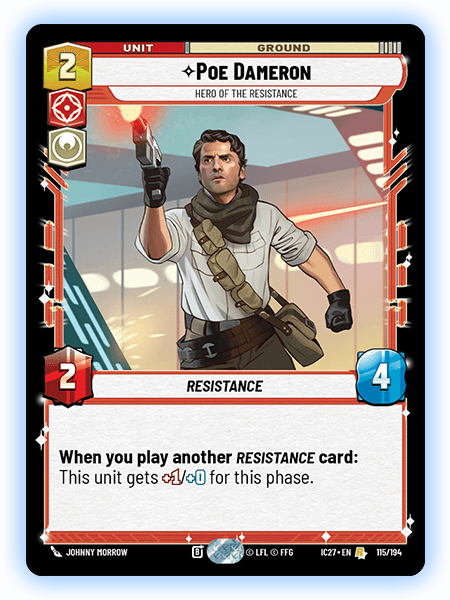
Let's get back to the Heroism side for a minute and highlight a true icon in the Resistance fight: Poe Dameron (Icons 2027 Edition, 115), another new card from this set. At 2-cost (shown in the top left), our “Hero of the Resistance” comes in fast, ready to fight with solid health and a strong ability: the more Resistance cards you play, the more Poe's power is bolstered for the phase. It's good to have friends, right?
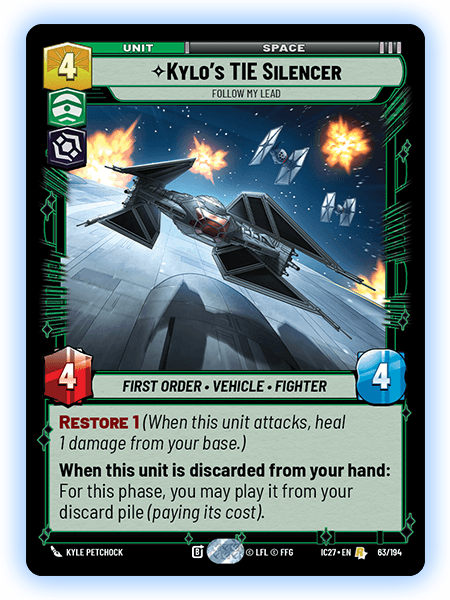
As in most Star Wars clashes, the battle on the ground is rarely the only battle being fought. In Star Wars: Unlimited, the space arena is just as important, and what better to showcase space dominance than Kylo's TIE Silencer (Icons 2027 Edition, 63)? At 4-cost, 4 power, and 4 HP, this ship soars into play after the game has progressed a few rounds. More than likely at this point in the game, your base will have sustained some damage. Thankfully, this card has an ability called “Restore,” which heals a bit of damage from your base when the unit attacks.
In addition, Kylo's TIE Silencer has a unique ability that allows you play it from your discard pile if the unit was discarded from your hand. This ability can come in clutch when it comes to staying in the fight, especially when your opponent least expects it!
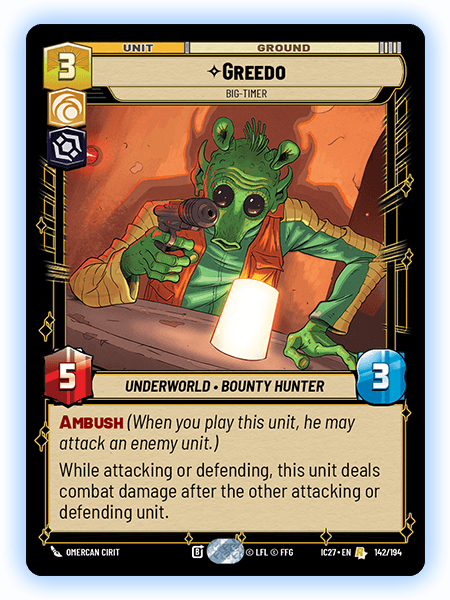
Back on the ground arena, we have another familiar face. Greedo (Icons 2027 Edition, 142) can be played early in the game at a 3-cost entry point. With his Ambush ability, this “Big-Timer” can strike an enemy unit hard with 5 power as soon as he's played. However, there's a little catch: the opponent's unit always deals damage first against him. Poor Greedo!
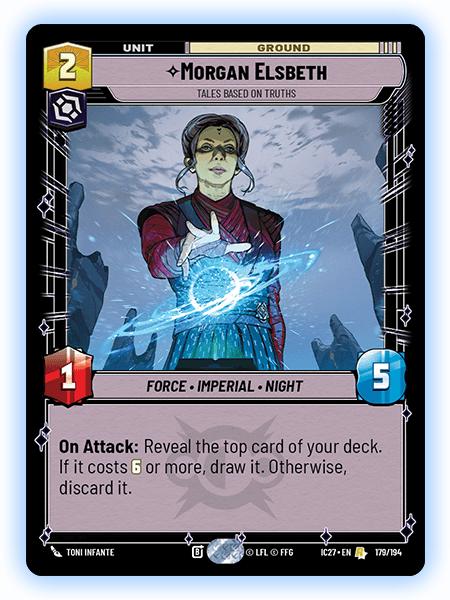
In the Villainy aspect, Morgan Elsbeth (Icons 2027 Edition, 179) is another low-cost card with some interesting mechanics at play. While her power may be low, she is bolstered by a high HP for her cost and an ability that triggers every time she attacks. This ability reveals the top card of your deck, and if it's a six-cost or more card, you may draw it; otherwise, discard it. Great for thinning your deck and searching for those late-game big plays!
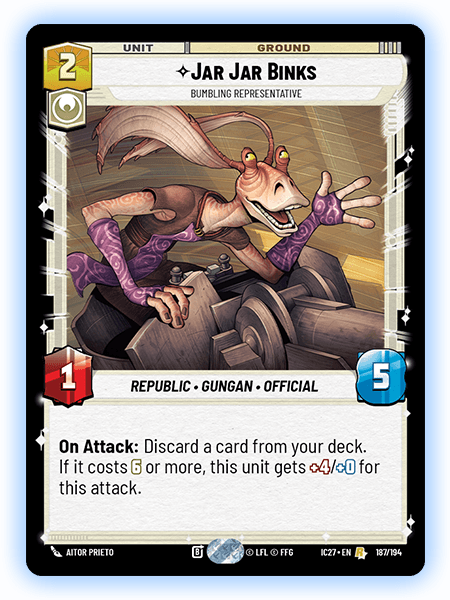
On the other side, Jar Jar Binks (Icons 2027 Edition, 187), is an interesting parallel to Morgan Elsbeth. Both cards share a similar cost and stats, as well as a mechanic based around 6-cost cards in your deck. However, instead of being able to draw a potential 6-cost card like Morgan, when Jar Jar attacks, you must discard a card from your deck, and if it costs at least 6 resources, he gets an incredible +4 power for that attack! Sometimes it pays off to be a “Bumbling Representative.”
Your Journey Begins
Whether you're completely new to trading card games, a returning Star Wars: Unlimited player, or a longtime fan looking to expand your collection, Icons 2027 Edition offers an easy way to jump into the adventure. New players can start with the Icons starter box and learn the game step by step, while experienced players can dive into booster packs and discover new cards to add to their decks. The wait is almost over, and with Icons, get ready to be part of a new journey!
Share This Post